
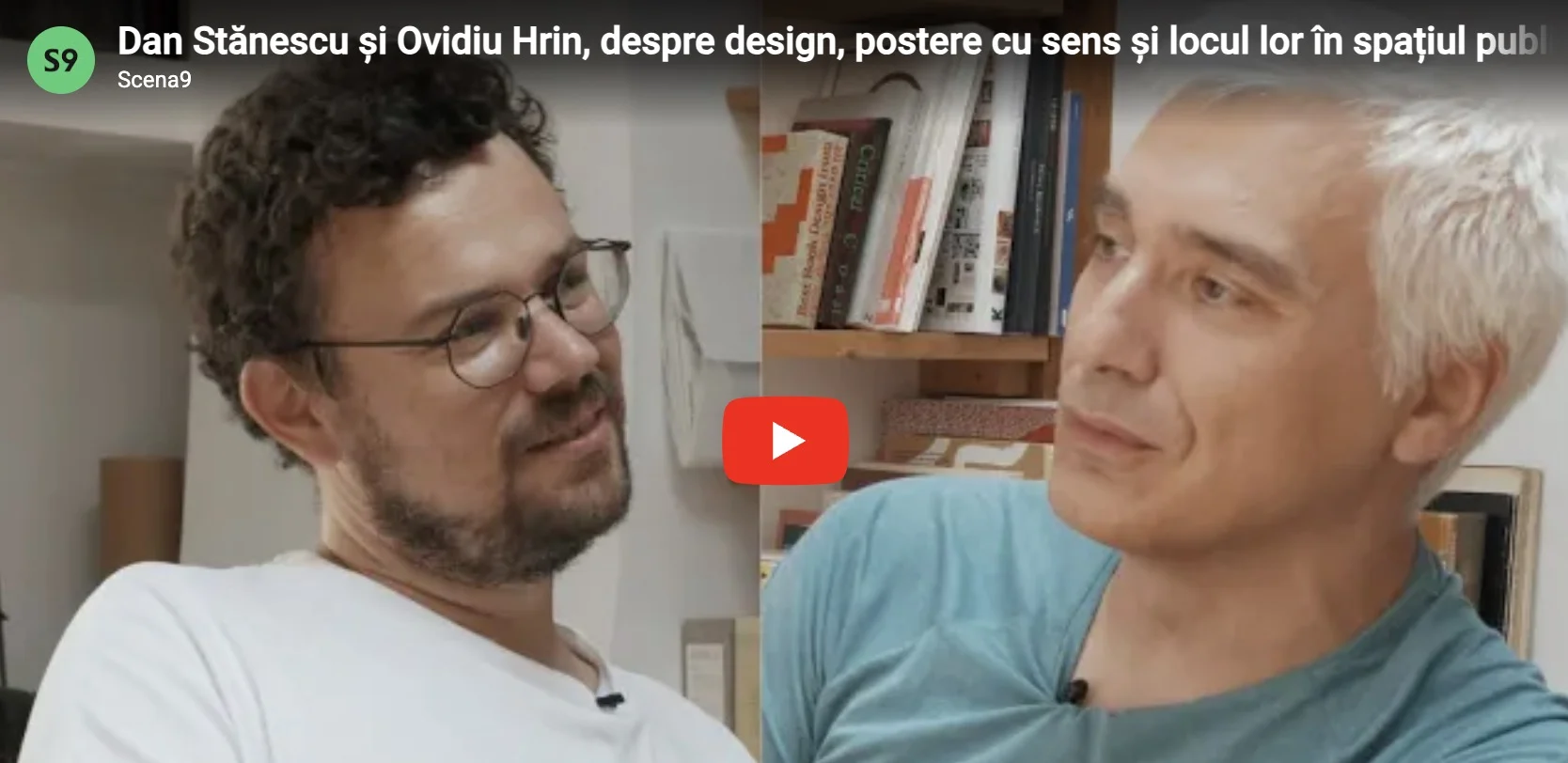
Meaningful poster design is at the heart of this conversation: Dan Stănescu, founder and creative director at Glitch, joined Ovidiu Hrin from Synopsis Media to discuss what it means to make a poster that actually matters. For Scena9’s Reciproc series, February 2025.
Layers of noise, meaningful poster design, and looking for a signal
Walk through Bucharest and you will see it: layers of posters competing for the same wall. Concert announcements stacked over opera flyers, magic show ads bleeding into political campaigns. Tudor Gheorghe covers Micaku who covers a Balkan brass festival. A visual cacophony that says everything and communicates nothing.
The conversation starts right there, with a photo Dan took of a wall in central Bucharest. A collage of competing messages so dense it becomes a kind of anti-poster: proof that volume kills communication. The designer of one of the posters on that wall, Dan notes, might as well have “surrendered.” The poster exists, but it doesn’t speak.
Romanian cities lack the infrastructure for meaningful public display. There are few accessible, well-designed posting spaces. The result is a visual free-for-all where the loudest wins, not the most considered. Ovidiu Hrin, who works in Timișoara, describes a similar struggle: years of trying to convince clients to print larger than A3, to treat the poster as something worth investing in, not just a cheaper alternative to a Facebook ad.
And yet both practitioners keep making posters. That tension, between a medium that nobody seems to need and a conviction that it still has something essential to offer, runs through the entire conversation.
The poster as the purest form of public communication
For Dan, meaningful poster design starts from a simple conviction: the poster is “the purest form of communication in public space. It’s free. It’s available to all.” That conviction came early, through discovering minimalist Brazilian advertising at the Adprint festival in the mid-2000s and, later, through working with Glitch on posters for cultural events where there was no budget for anything else. Five copies printed, four taped to the window of Elvira Popescu cinema for an F-Sides screening. After the screening, the audience takes them home. The poster lives for two, maybe three hours.
That constraint is productive. One surface. One idea. One moment of attention from a stranger who didn’t ask for it. The poster doesn’t have the luxury of a second page, a scroll, a click-through. It earns its place or it disappears.
Ovidiu arrives at the same point from a different direction. A trained architect who discovered graphic design through a private university’s library (the books, not the courses), he spent years studying calligraphy under master Tashi Mannox before understanding what it taught him about design: observation. “In the first five years you are a beginner. Between five and ten, intermediate. Ten to twenty, professional. Twenty to twenty-five, master. And from twenty-five to forty, you are a beginner again.” That cycle of expertise dissolving into freshness is, for Ovidiu, what separates a poster that works from one that merely looks correct.
One variant, not three
One of the most revealing moments in the conversation is a practical disagreement. At Glitch, we typically present three options to a client. At Synopsis Media, Ovidiu presents one.
His reasoning is sharp: presenting three variants projects indecision. It lets the client choose based on what colour their spouse likes, or what mood they’re in that day, rather than trusting the designer’s judgement. “I wanted to escape the bullshit,” he says plainly. Instead, he invested in reading, exposure, expanding bandwidth, until the single answer became the honest one.
Dan’s approach is different but the underlying principle is the same: the poster has to justify its own existence. Not aesthetically, but functionally. Who is it speaking to? What does it ask of them? When you start there instead of at the visual, the whole process changes. Whether you arrive with one option or three, the question is the same: does this poster need to exist, and if so, does it earn the attention it asks for?
Is it anachronistic to care about physical things?
The conversation keeps circling back to a question that matters beyond poster design: is it anachronistic to care about physical media in a world of screens?
Dan raises it directly, about the Glitch Library: “Is it anachronistic to build a library in a world of Pinterest and Instagram?” The answer, he suggests, is yes, and that’s precisely the point. The anachronism is the value. The tactility, the weight of paper, the materiality of a thing you hold in your hands versus what he calls “the invisible volumetry” of a phone screen.
Ovidiu agrees. The poster and the book share something: they are real objects in real space. They don’t refresh, they don’t scroll, they don’t optimise for engagement. They sit there and wait for you to meet them. In a visual culture that has become almost entirely ephemeral, that permanence (however brief, even if it’s three hours on a cinema window) becomes a form of resistance.
This is the same thinking behind Glitch Library: almost 1,000 books on design, visual culture, typography, photography and critical theory. No algorithms. Just shelves, chairs, and the kind of accidental discovery that only happens when you browse without a search bar.
What a poster hides
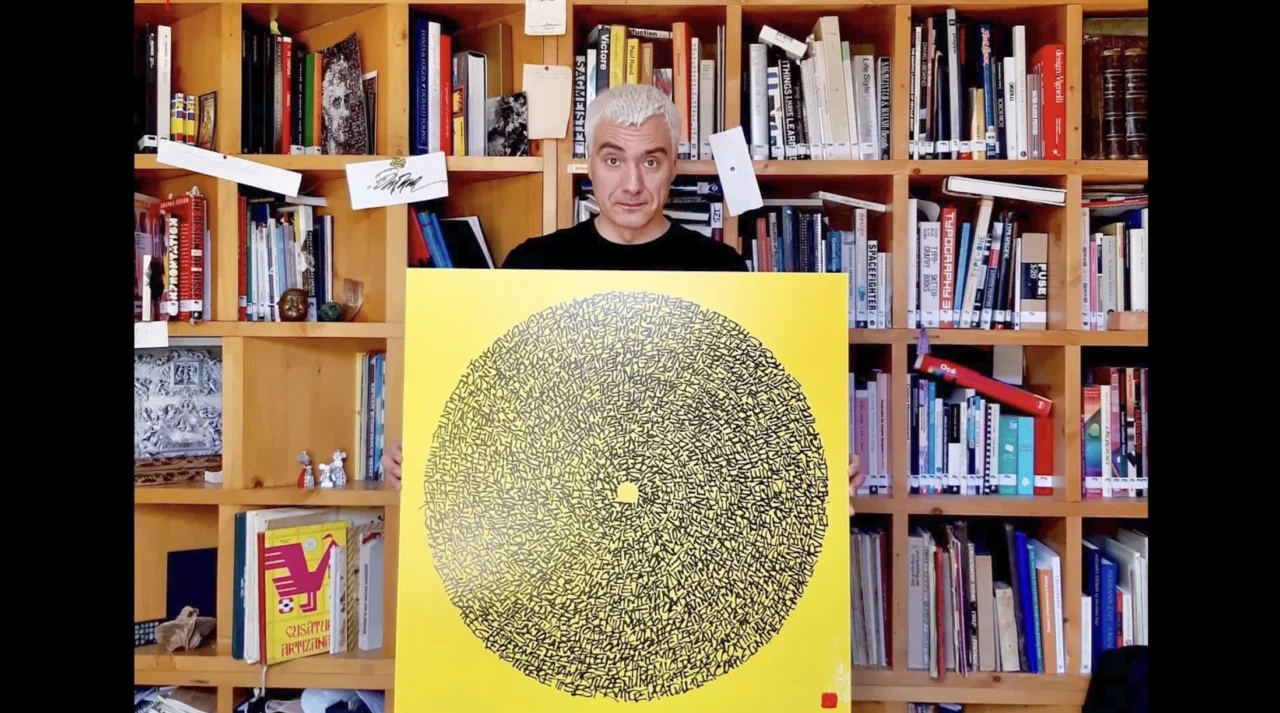
Dan asks Ovidiu directly: “Do you ever hide things in your work?” The answer opens up an unexpected thread about intention, craft, and the invisible layers that separate decoration from communication.
In a good poster, something is always withheld. Not as a trick, but as trust: trust that the viewer will complete the thought. The best posters, both agree, are not the ones that explain everything. They are the ones that stop you for five seconds on the street. That create, as Ovidiu puts it, “a world” rather than just delivering information.
This matters for anyone working in cultural communications. The instinct in a noisy environment is to say more, louder. The discipline is to say less, but mean it. That is the difference between a poster and an ad. Between communication and noise.
Venice, Bucharest, and the infrastructure of visual culture
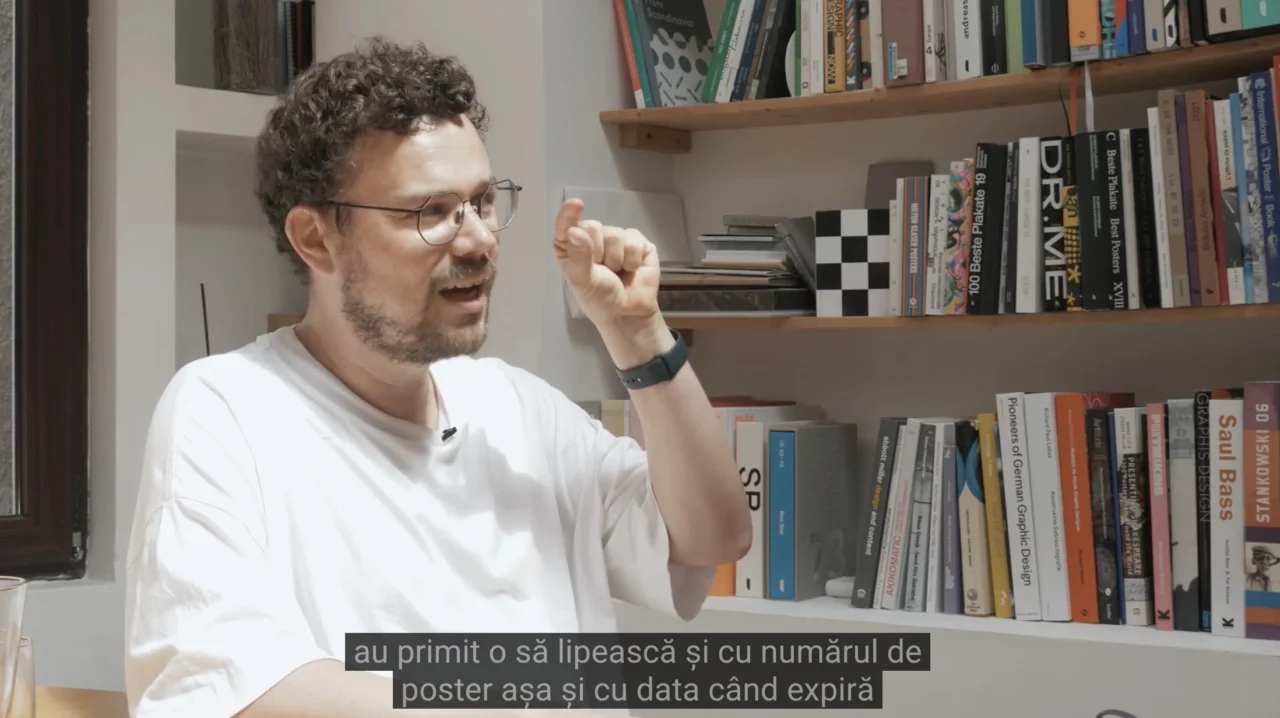
The most striking comparison in the conversation is between Bucharest and Venice. Both cities are covered in posters. But in Venice, every poster carries a stamp: an authorisation number, an expiration date, proof that the city treats its visual space as something worth governing. The result is not less visual energy. It is more meaningful visual energy.
Bucharest has no such infrastructure. The clandestine poster economy produces juxtapositions that are sometimes hilarious, sometimes tragic, always chaotic. Designing for that context, both practitioners argue, means designing with the city as an active participant, not a neutral backdrop. The poster doesn’t exist in a gallery. It exists next to Tudor Gheorghe, next to a political ad, next to someone sleeping under it.
That context is what makes thoughtful poster design more relevant, not less. A poster that holds its own in chaos, that earns a second glance rather than demanding it through scale or shock, is doing something worth understanding.
Poster x Poem: when the conversation becomes practice
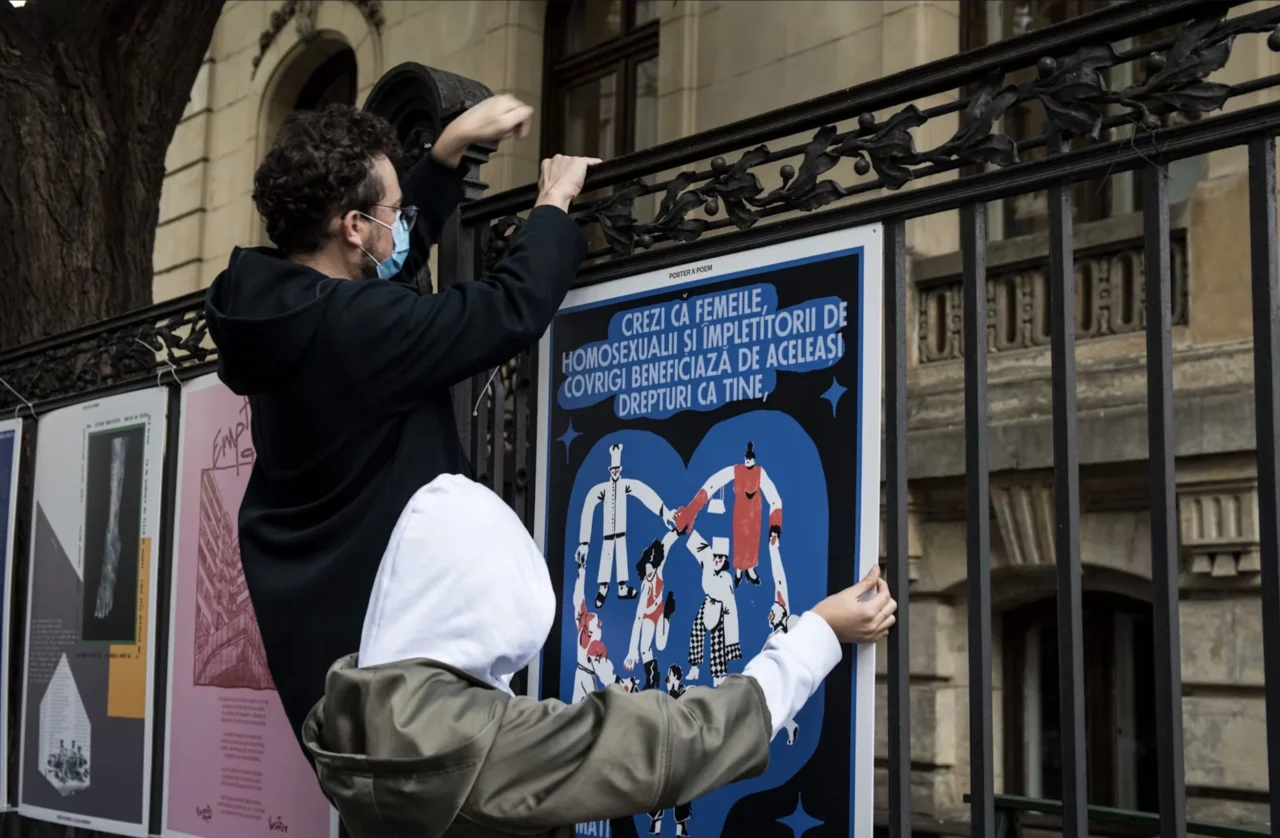
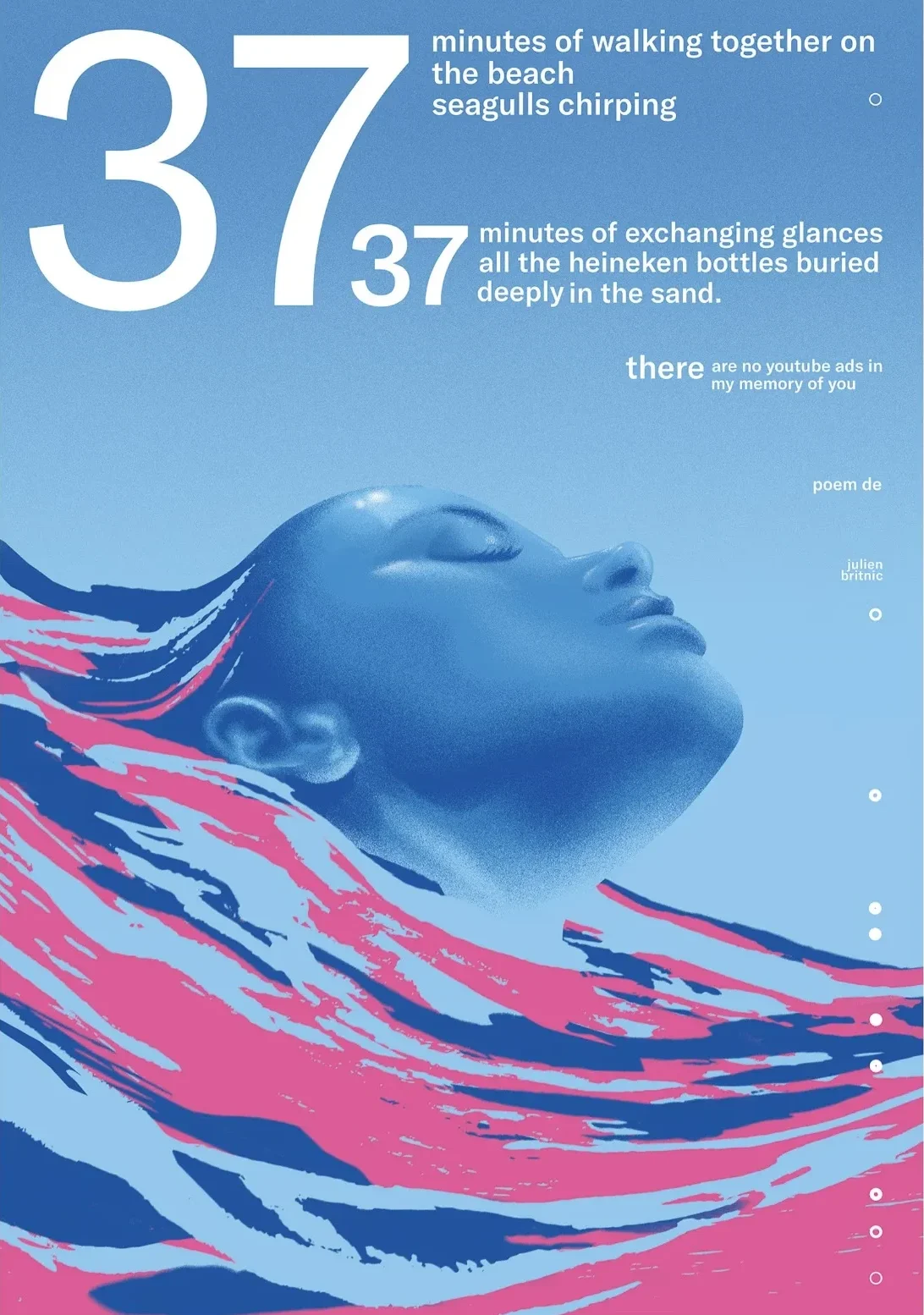
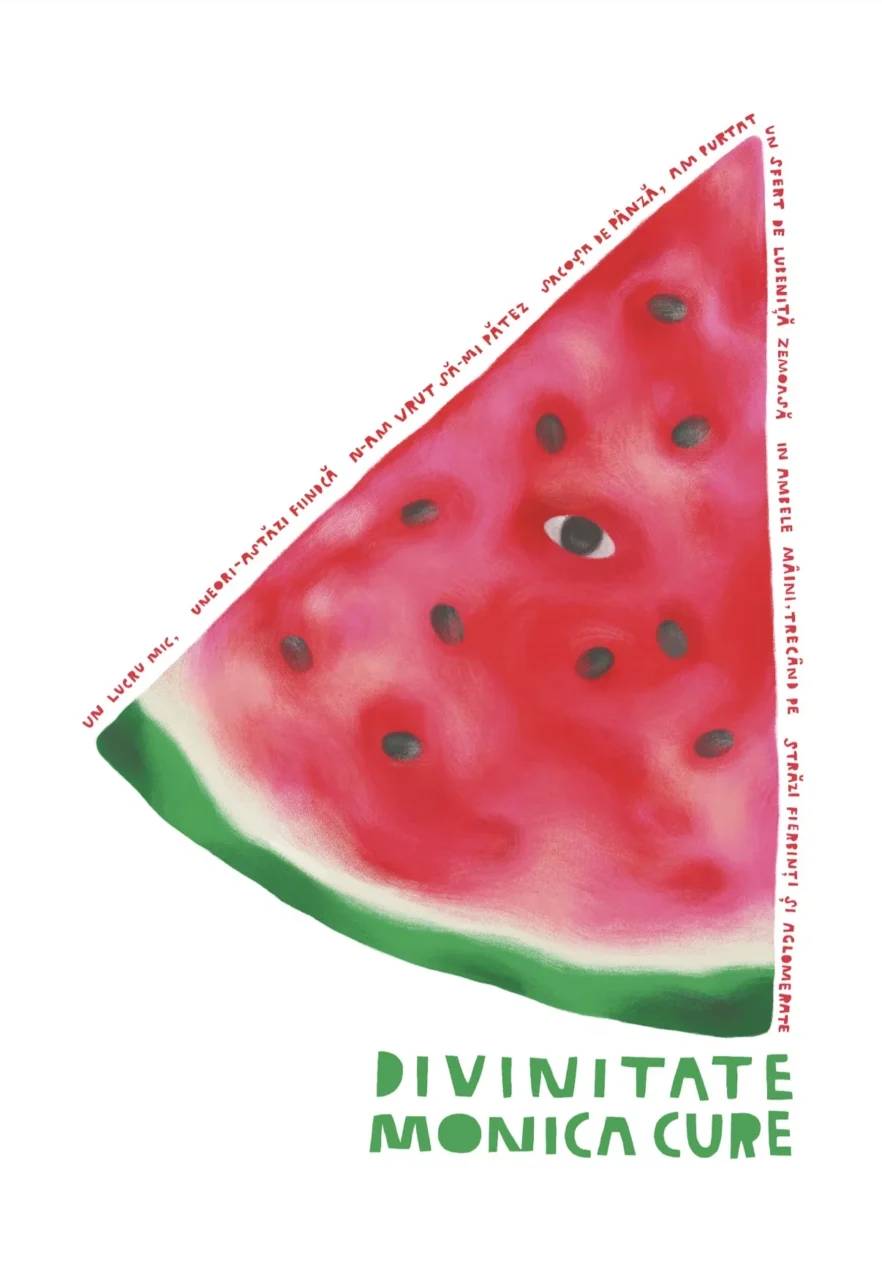
The relationship between Dan and Ovidiu extends beyond this video. Both have been involved in Poster x Poem, a project initiated by Asociația Glitch and Asociația Room 2046 that pairs contemporary poets with designers, typographers, and visual artists to create posters. One rule: the poem must be in the poster. The belief is that poems should exist beyond books. Not only read or heard, but seen.
Poster x Poem has travelled through Bucharest, Chișinău, and Brașov. When the exhibition arrived in Timișoara, Ovidiu hosted a poster-making workshop, bringing together local participants to work with the format in practice, not just in theory. A city engaging with its own visual and literary culture, in real time, with real makers. Explore all four editions at posterxpoem.com.
Where these conversations continue
At Glitch Library (Vasile Conta 8-10, Bucharest), we run an ongoing programme of Design Sessions and Artist Talks that treat books as a starting point for live conversation. These events are a direct extension of what Dan and Ovidiu discuss here: meaningful poster design, visual culture, and the relationship between physical objects and public space. Browse our work or get in touch to learn more.
In October 2024, the Library hosted Richard Niessen and Esther de Vries, two of the most respected names in contemporary Dutch graphic design. Niessen, known for The Palace of Typographic Masonry and his teaching at KABK in The Hague, gave a public conference at Rezidența9. De Vries, whose editorial work has been repeatedly recognised at Best Dutch Book Designs, presented her process in the more intimate setting of the library itself.
Glitch’s work in purpose-driven design and cultural communications has appeared in Romanian Design Week exhibitions for three consecutive years. In 2024, the #IubimLaFel campaign for Asociația MozaiQ won Prize I at the Gala Societății Civile and a Golden Award at the Romanian PR Awards.
If the questions in this conversation interest you, the Library is where they continue in person. And the full Scena9 Reciproc episode is where they start.
Glitch is a purpose-driven communications studio based in Bucharest. We work on strategy, branding, campaigns, and cultural communications for organisations that want their work in the world to matter. Our interest in meaningful poster design and visual culture is not incidental — it’s part of how we think about what we do and why.