

These are the naming books we recommend most often. Why your brand’s name matters more than you think, and what to read to get better at the craft of naming.
Contents
- Why naming is the most underrated creative discipline
- Top 10 books on naming and the art of giving names
- Bonus: 5 adjacent books you can find at Glitch Library
- How to read them: recommended order
- What comes after books: naming as practice
Why naming is the most underrated creative discipline — and why naming books matter
Everyone talks about logos, brand identity, campaigns, tone of voice. Few people talk about naming, and when they do, it’s usually in a meeting room at 5:45 PM when someone asks: “but what do we call it?”
In Wordcraft (2004), journalist Alex Frankel follows the stories behind commercial names, including BlackBerry and Accenture. Those accounts show the decisions, arguments and accidents involved. They are case histories, not a controlled comparison of recall or loyalty.
Naming sits at the intersection of at least four disciplines: linguistics (which sounds carry which meanings), strategy (how to differentiate in a crowded market), cognitive psychology (how the brain processes a new word) and culture (what resonates in a specific context).
There is no university degree in naming. There is no single book that covers everything. But the right naming books, read in combination, transform you from a creative who “thinks of a name” into one who designs a name. Below are the 10 titles we return to most.
Top 10 books on naming and the art of giving names
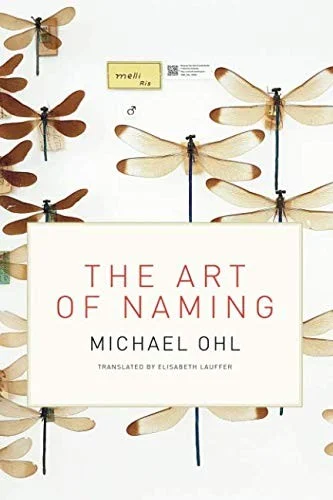
1. The Art of Naming, Michael Ohl (2018; paperback 2019)
For anyone curious about how names organise the world, well beyond branding.
Biologist Michael Ohl explores the naming of species: how scientific names are chosen, who gets to choose them and what those choices reveal. The Art of Naming, translated by Elisabeth Lauffer, was published by MIT Press in 2018, with a paperback edition in 2019. Its subject is taxonomy. For a naming practitioner, that opens a different set of questions about classification, memory and the stories a name carries.
Key idea: Naming is also an act of classification. The rules behind a name tell you something about the people and institutions choosing it.
Read this if you want to look beyond commercial naming and see how another discipline handles the task.
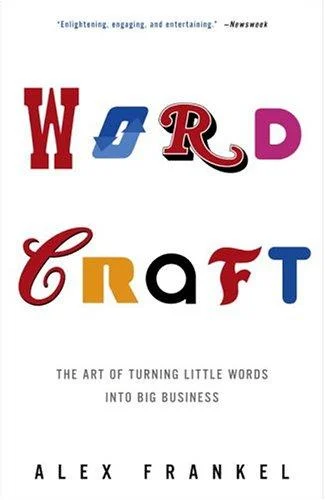
2. Wordcraft: The Art of Turning Little Words into Big Business, Alex Frankel (2004)
For brand strategists, entrepreneurs, anyone who wants real stories from the industry.
Frankel reports on the people and processes behind names including BlackBerry, Accenture, Viagra, Cayenne and IBM’s e-business. This is investigative journalism applied to naming: how a word gets proposed, argued over and eventually put into the world.
Key idea: A naming presentation is only part of the story. Look at the product, the people making the decision and the language customers actually use.
Read this if you want real case studies, not theory.
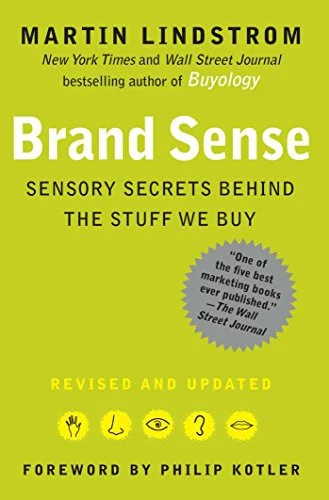
3. Brand Sense: Sensory Secrets Behind the Stuff We Buy, Martin Lindstrom (2005)
For creatives, strategists, brand managers who want to understand branding beyond the visual.
Lindstrom argues for branding across the senses, including sound, touch and smell alongside visual identity. For naming, the useful prompt is simple: say the word aloud. A name is heard as well as read. “Silk” and “Crunch” invite very different associations before anyone sees a logo.
Research collected in Sound Symbolism examines relationships between speech sounds and perceived qualities. These patterns can inform a naming exploration, but they are not a universal code for luxury, speed or warmth. Language and context matter. Treat sound as something to explore and test with the intended audience.
Key idea: A brand name that activates multiple senses (not just sight) creates a complete sensory experience and a stronger memory.
Read this if you want to understand why some names feel different from others.
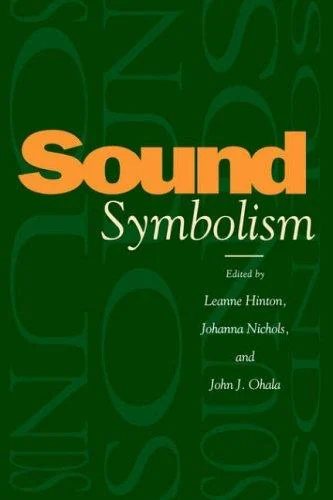
4. Sound Symbolism, Hinton, Nichols & Ohala, eds. (1994, Cambridge University Press)
For naming nerds, linguists, those who want the scientific foundation.
This collection, edited by Leanne Hinton, Johanna Nichols and John J. Ohala, brings linguistic research on sound and meaning together. Its value for naming is the range of questions it opens: when does a sound suggest size, shape or movement, and how does that relationship change across languages?
Try saying candidate names aloud at different speeds, in a sentence and over the phone. Listen for what changes. Sound symbolism gives you hypotheses to explore, not a formula that guarantees the same response from everyone.
Key idea: Sound contributes to meaning. Test the associations a name invites rather than assuming you can programme a response.
Read this if you want to bring a linguistic perspective to the naming process.
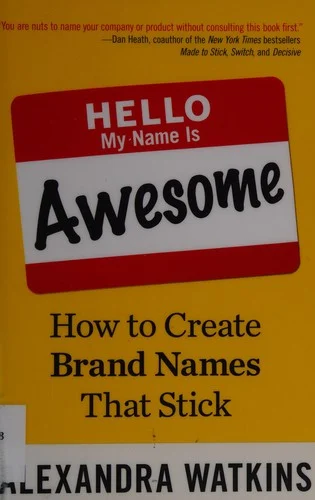
5. Hello, My Name Is Awesome, Alexandra Watkins (2014)
For entrepreneurs, startup founders, non-creatives who need to name something.
The most practical and accessible book on this list. Watkins proposes the SMILE/SCRATCH framework: five qualities a good name has (Suggestive, Meaningful, Imagery, Legs, Emotional) and seven mistakes to avoid (Spelling challenged, Copycat, Random, Annoying, Tame, Curse of knowledge, Hard to pronounce).
The SMILE/SCRATCH framework gives a team shared criteria for discussing candidates. That makes it a useful filter when everyone has a favourite but nobody has explained why.
Key idea: A name doesn’t have to be clever. It has to be easy to love. If you need to explain it, it doesn’t work.
Read this if you have a naming brief on the table and need a rapid framework.
6. The Act of Creation, Arthur Koestler (1964)
For anyone who wants to understand the mechanism of creativity, not just in naming, but in everything.
Koestler introduces the concept of bisociation: the moment when two completely different frames of reference collide and produce something new. Humour, scientific discovery and art all operate on the same principle. In naming, bisociation is literally the generative process.
When you have a brief for a luxury lingerie brand and you encounter the story of cobalt (named after the kobold, the demon in mines who hid treasures underground), a bisociation occurs: precious things hidden beneath the surface. That is not a name. It is a naming territory from which 50 names can emerge.
Key idea: Creativity is not mystical inspiration. It is calculated collision between unconnected domains. The more diversely you read, the more fuel you have for collisions.
Read this if you want to become more creative at a structural level, not just at the output level. You’ll find this one in the Glitch Library collection.
7. Metaphors We Live By, Lakoff & Johnson (1980)
For strategists, copywriters, linguists, naming practitioners.
Lakoff and Johnson demonstrate that metaphor is not a literary ornament. It is the structure of thought. We say “I lost time” because we think of TIME AS A RESOURCE. We say “the relationship is moving forward” because we think of LIFE AS A JOURNEY. These conceptual metaphors are invisible, but they dictate how we understand everything.
In naming, this means every category has a dominant metaphor. Luxury lingerie lives in the metaphor INTIMACY AS PRIVATE SANCTUARY. Fintech in MONEY AS SPEED. Organic food in NATURAL AS AUTHENTIC.
When you name a brand, you don’t invent a metaphor. You connect to an existing one or you subvert it. The most powerful names do the second: Apple in a category dominated by technical acronyms.
Key idea: Human thought is fundamentally metaphorical. A good brand name activates the right metaphor without making it explicit.
Read this if you want to understand why certain names work at a deep cognitive level. Also available in the Glitch Library catalogue.
8. Antimony, Gold, and Jupiter’s Wolf: How the Elements Were Named, Peter Wothers (2019)
For anyone looking for unconventional sources of inspiration. Advanced naming nerds.
A book about chemistry that is actually about naming. Every chemical element has a story: cobalt is named after the mine demon. Nickel comes from Kupfernickel, “the devil’s copper.” Phosphorus means “light-bearer.” Yttrium, terbium, erbium and ytterbium: four elements named after the same Swedish village (Ytterby). Polonium: Marie Curie’s political declaration, naming the element after a country that didn’t officially exist.
For naming, these stories suggest several starting points: a place, a material, a conflict or a cultural reference. The useful exercise is to turn a story into a territory for exploration, then check what survives in a short, usable name.
Key idea: The best names in history (whether of elements, planets or species) encode a story into a single word. Not a description. A story.
Read this if you have read everything that exists about “proper” naming and want a radically different perspective.
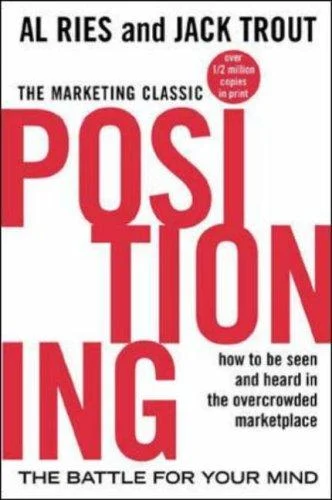
9. Positioning: The Battle for Your Mind, Al Ries & Jack Trout (1981/2001)
For anyone working in marketing and branding. An absolute classic.
Naming doesn’t happen in a vacuum. It happens in a competitive landscape. Ries and Trout invented the concept of positioning, and the most important chapter in the book is about names: a brand name is the single most important positioning decision. A descriptive name anchors you to a category. An abstract name liberates you but requires investment to build meaning. A name that evokes a metaphor positions you instantly.
For a naming brief, the useful question is what the name helps people understand about the offer. A change of name can signal an ambition. The organisation still has to deliver it.
Key idea: A brand name is not identity. It is mental position. The question is not “how does it sound?” but “where does it place you in the consumer’s mind?”
Read this if you want to understand naming as a strategic weapon, not just a creative exercise.
10. Star Names: Their Lore and Meaning, Richard Hinckley Allen (1899/Dover)
For poets, dreamers, those searching for raw material.
A book from 1899 about how the stars were named. Why is it on this list? Because it is the richest source of rare, beautiful and multilingual words you will ever find.
Allen gathers historical names and traditions associated with the night sky. For naming work, the attraction is this accumulation of language and stories. Treat a nineteenth-century account as a historical source, and check individual etymologies against current scholarship before building a brand story around them.
For a naming practitioner, this book is a source of seed words and stories. Each candidate still needs pronunciation checks in the intended languages and a proper trademark search. Age and obscurity do not make a name available.
Key idea: The best naming sources are not dictionaries. They are the nomenclature traditions of other disciplines.
Read this if you want to explore a vocabulary outside the usual branding references.
Bonus: 5 adjacent books you can find at Glitch Library
Glitch Library is a knowledge sharing space and idea exchange place in Bucharest, with almost 1,000 titles on art, design, visual culture and critical theory accessible to the public. Among them, several are directly relevant to naming, even if they are not “naming books”:
Branding: In Five and a Half Steps, Michael Johnson (2016)
The best branding book of the last decade. Step 3 is about naming, but the entire framework informs how you think about a name in context.
Design as Art, Bruno Munari (2019)
Munari teaches you to see the familiar as something new. That is exactly what naming does: takes a word and makes it mean something else.
The Copy Book, D&AD (2018)
The best copywriting minds in the world explain how they write. Naming is copywriting compressed to a single word.
The A-Z of Visual Ideas, John Ingledew (2011)
A manual for visual ideation that works perfectly for verbal ideation too. The generation techniques are identical.
In the Name of, Charlie-Camille Thomas (2021)
A direct exploration of the name as an act of power, identity and design. The closest thing to naming proper in the Glitch Library collection.
All of these naming books are available for consultation at Glitch Library in Bucharest (Vasile Conta 8-10, 2nd floor) — a space dedicated to the intersection of art, design and visual culture, open to the public. Browse the full catalogue of naming books and visual culture resources on LibraryThing.
How to read them: recommended order
If you have a day:
Read Hello, My Name Is Awesome (2-3 hours). You’ll have a functional framework.
If you have a week:
Add Wordcraft (real stories) + Positioning (strategic context). Now you understand the why and the how.
If you have a month:
Read The Art of Naming + Brand Sense + Metaphors We Live By. Now you have a complete mental model.
If you want mastery:
Add Sound Symbolism + The Act of Creation + Antimony, Gold + Star Names. Now you have sources that nobody else in the industry has.
What comes after books: naming as practice
Naming books give you the foundation. But naming is learned like any craft: through practice. A few exercises we recommend once you’ve worked through your reading list:
- Daily reverse-engineering: Pick a brand name you admire. Disassemble it: where does it come from? What naming strategy does it use? What metaphor does it activate? What does it sound like when you pronounce it?
- 100 names in 30 minutes: Take any brief (real or imagined) and generate 100 names without judgement. The first 30 are obvious. 31-70 get interesting. 71-100 get strange. That is where the gold is.
- Read outside the discipline: The best naming insights come from taxonomy, astronomy, perfumery, mineralogy, mythology. A naming practitioner who only reads branding books is like a chef who only eats fast food.
This article was written by the team at Glitch, a design and branding studio in Bucharest. We do naming as part of our branding process, informed by the naming books and research in linguistics, cognitive psychology, and brand strategy listed above. If you’re working on a naming challenge, get in touch.